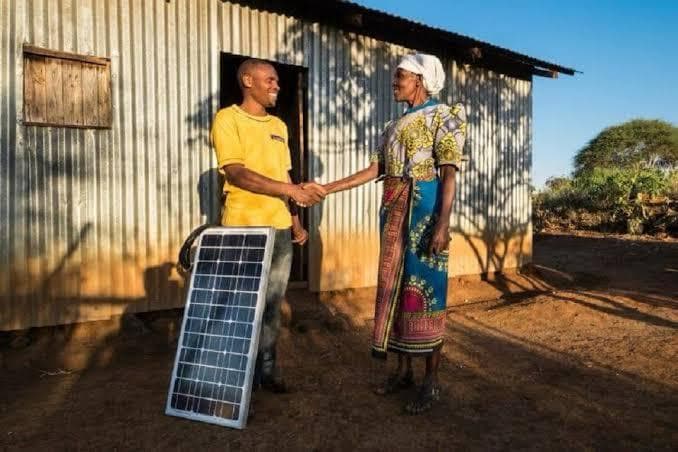
The next generation of energy access will not be defined by solar panels alone. It will be defined by how intelligently those systems are designed, monitored, maintained and adapted to the people using them.
Solar energy has already changed what is possible for communities located beyond reliable grid infrastructure. Households can generate electricity where they live, businesses can operate without depending completely on petrol and diesel generators, and clinics and schools can receive electricity even in locations where conventional electricity infrastructure is weak or absent.
Mini-grids and standalone systems have already demonstrated that electricity does not always need to travel through a large centralized network before reaching a customer.
But as our previous article explored, decentralized solar creates a new challenge. The more distributed the systems become, the more complex they become to operate.
Decentralized energy solves the distance problem. AI and digital infrastructure can help solve the complexity problem.
Why decentralization matters in the first place
Traditional electricity networks were built around a relatively simple structure. Electricity was generated at large power stations, moved through transmission networks, and then delivered to customers through distribution infrastructure.
Decentralized energy changes that structure because electricity can be generated much closer to where it is consumed.
A household can have its own solar generation. A micro-business can operate its own battery-backed system. A clinic can have dedicated energy infrastructure. A community can operate a mini-grid.
This is particularly important for rural and underserved communities because extending conventional grid infrastructure can be expensive and slow.
The World Bank continues to identify decentralized renewable energy as an important part of closing Nigeria's electricity-access gap. Nigeria's experience with mini-grids and standalone solar systems has already demonstrated that distributed electricity can reach communities that conventional infrastructure struggles to serve.
Decentralized energy changes the question from “When will the grid reach this community?” to “How can electricity be generated where it is already needed?”
But thousands of decentralized systems create a new operational problem
Imagine an energy company serving ten customers. A technician can know most of them personally. If a system fails, someone can visit the location. Payments can be tracked manually and system sizes can be decided one customer at a time.
Now imagine serving 10,000 customers spread across hundreds of communities.
Which batteries are beginning to degrade? Which customers are consuming more electricity than expected? Which systems are underused? Which customers need additional capacity?
Which systems may fail soon? Which customers have paid? Where should technicians be sent first? Which faults can be solved remotely? Which communities are experiencing rapidly growing electricity demand?
Without digital infrastructure, answering these questions across thousands of systems requires enormous amounts of manual work.
The problem is no longer only generating electricity. It is managing thousands of small electricity systems efficiently.
Every decentralized energy system can become a source of useful data
Modern solar systems can generate far more information than simply whether the lights are on or off.
A connected system can potentially record solar generation, battery state of charge, battery voltage, energy consumption, peak demand, charging and discharging patterns, inverter performance, fault events and time-of-day energy use.
When combined with customer and operational information, this creates something extremely valuable: visibility.
Instead of operating thousands of energy systems blindly, an operator can begin to understand what is happening across the entire network.
But collecting data is only the first step. The harder question is how to interpret increasing amounts of information quickly enough to make useful decisions.
This is where artificial intelligence becomes useful
Artificial intelligence is particularly useful for identifying patterns across large amounts of data. In an energy system, those patterns can help answer practical operational questions.
The International Energy Agency has identified several areas where AI can improve electricity systems, including renewable generation forecasting, demand forecasting, fault detection, predictive maintenance and system optimisation.
IRENA has similarly examined how digital technologies, artificial intelligence and data analytics can help renewable mini-grid operators better understand electricity demand and generation.
AI does not create electricity. It helps the energy system make better decisions about the electricity it already has.
AI can help predict how much electricity customers will need
One of the hardest parts of designing decentralized energy systems is predicting demand.
If a system is too small, customers experience shortages. If it is significantly oversized, the provider spends money on equipment that may not initially be necessary.
Traditional assessments may rely on surveys asking customers what appliances they own, how many lights they use, whether they operate a refrigerator, and what equipment their businesses require.
These questions remain useful, but actual usage data can reveal much more.
Over time, analytical models can examine consumption patterns, customer behaviour, time of day, seasonality and other factors to build a better picture of electricity demand.
A shop may use more electricity on market days. A household may consume more during hotter months because of fan use. A clinic may have a stable base load but occasional high-power requirements.
A productive-use customer may show steadily increasing consumption as the business grows.
Understanding these patterns can support better system sizing and future capacity planning.
AI can also help predict renewable-energy production
Solar generation depends on environmental conditions. Cloud cover, seasons and local weather patterns all affect how much electricity a solar system produces.
Renewable-energy systems therefore need to manage both variable supply and changing demand.
AI can combine historical solar output with weather information and other data to improve generation forecasts.
Better forecasts can allow an energy-management system to make smarter decisions about when to charge batteries, when to conserve stored energy and how much electricity is likely to be available later.
Better forecasting means the system can make more informed decisions before electricity becomes scarce.
AI can help protect one of the most expensive parts of the system: the battery
Battery storage is one of the most important and expensive parts of an off-grid solar system. It is also one of the components most affected by how the system is operated.
Batteries degrade over time. High temperatures can affect performance. Frequent deep discharge can reduce useful life for some battery chemistries, while improper charging can create additional stress.
A conventional maintenance model may only discover a battery problem after the customer begins complaining.
A more intelligent system can continuously observe performance. Is usable capacity declining? Is voltage behaviour becoming abnormal? Is the battery charging differently from similar systems? Is temperature consistently outside the expected range?
AI-assisted analytics can help identify patterns associated with deterioration.
This does not eliminate the need for technicians. It gives technicians better information.
The goal is to move from discovering failures after they happen to identifying warning signs before customers lose electricity.
Predictive maintenance can reduce one of the biggest costs of decentralization
Traditional maintenance often follows one of two models. Technicians either visit equipment on a fixed schedule or wait until something fails.
Both approaches can be expensive for distributed systems.
Scheduled maintenance can result in unnecessary travel to systems that are working perfectly. Reactive maintenance can mean the customer remains without electricity until a technician arrives.
Predictive maintenance offers another approach.
Performance data can be analysed continuously to identify equipment behaving abnormally. The operator can then prioritize systems where intervention is most necessary.
Technicians can know which components may need attention before travelling. Spare parts can be prepared in advance and several maintenance visits within the same area can potentially be coordinated.
This can reduce both downtime and operating costs.
AI can improve customer assessment before a system is installed
Not every household or business needs the same energy system.
One shop may need only lighting and phone charging. Another may have refrigeration. Another may operate equipment with high starting loads.
AI-assisted assessment can combine structured information about appliances, business activity, affordability, historical usage and other relevant factors.
This can help providers recommend systems that are better matched to actual customer requirements.
Better sizing can reduce two costly mistakes: installing too little capacity and installing more equipment than is necessary.
Better intelligence can support more flexible affordability models
One of the greatest barriers to solar access remains affordability. A low-income customer may need electricity but lack the money to purchase an entire system upfront.
Digital energy platforms can create a more flexible relationship between infrastructure and payment.
Rather than simply selling equipment, providers can offer electricity as a service. Customers can pay according to an agreed service level, while digital payment records reduce manual collection and improve operational visibility.
The objective is not to sell the biggest system possible. It is to provide the right amount of reliable electricity at a cost the customer can sustain.
Energy-as-a-Service can change the relationship between the customer and the hardware
Traditional solar often places the burden of equipment ownership on the customer.
The customer purchases the panels, battery and inverter. When the battery eventually needs replacement, the customer may again face a significant capital expense.
Energy-as-a-Service changes that relationship.
The provider owns or manages the infrastructure while the customer pays for access to electricity.
This creates a stronger incentive for the provider to keep the system operational because if the equipment fails, the provider loses the ability to deliver the service.
AI and digital monitoring can make this model more practical because one provider can manage large numbers of distributed systems through a common digital environment.
Remote operations can reduce unnecessary field visits
Distance is one of the hidden costs of rural energy. A technician may need to travel for hours to reach a customer.
If the technician arrives without enough information, the problem may not be solved during the first visit.
Remote monitoring can provide information before the technician leaves. What error is present? What was the battery voltage before the failure? Has solar generation dropped? Did customer demand suddenly increase?
This visibility can reduce unnecessary travel and improve the chances that a technician arrives prepared for the actual problem.
Intelligent load management can make limited energy go further
Off-grid energy systems operate with finite resources. There is only so much generation available and battery storage has a fixed capacity.
During periods of low solar generation or unusually high demand, choices may need to be made about how electricity is used.
Intelligent energy-management systems can prioritize essential loads, reduce non-essential consumption during periods of low battery capacity, and shift flexible loads to times when solar generation is abundant.
When energy is limited, intelligence can help determine how to use that energy more effectively.
AI can help decentralized systems grow with the customer
One of the limitations of fixed solar systems is that the customer can outgrow them.
A household that begins with lighting may later purchase a television, refrigerator or additional appliances. A small business may expand. A clinic may add equipment. A farmer may add irrigation or processing machinery.
Instead of waiting for customers to complain that their systems are no longer sufficient, usage data can reveal rising demand.
AI-assisted analytics can identify customers whose consumption is consistently approaching the limits of their current systems.
The provider can then plan an upgrade.
Customers begin with what they need today, while their energy infrastructure can grow as their lives and businesses grow.
Smarter energy systems can support productive use, not just basic access
Electricity access should not end with lighting.
Its economic impact becomes much larger when electricity supports refrigeration, milling, irrigation, welding, food processing, digital services, healthcare, education and small manufacturing.
These activities create income and can improve the economics of decentralized energy systems.
AI and demand analytics can help providers understand where productive demand is emerging, allowing energy infrastructure to be expanded where it can create greater economic value.
Intelligence should also extend to the lifecycle of the hardware
The energy-access sector also needs to think beyond the first use of solar equipment.
As solar deployment grows, more batteries, panels and electronics will eventually reach the end of their first useful life.
Digital records can help track equipment throughout its useful life. When was the battery installed? How has it performed? Has capacity degraded? Should it be replaced?
Where appropriate, tested components may retain value for safe second-life applications, while other components will require responsible recycling.
AI does not replace proper testing, battery management systems, engineering judgement or safety standards. But better data can support more informed decisions about the lifecycle of energy hardware.
A truly intelligent energy system should understand not only how equipment is used, but when it should be repaired, replaced, recovered or recycled.
AI should support technicians and communities, not replace them
Artificial intelligence will not eliminate the need for energy engineers or trained solar technicians.
It will not repair a damaged cable by itself. It will not replace community engagement and it will not replace good electrical design.
Instead, AI can help those people work more effectively.
A technician with accurate diagnostic information can solve problems faster. A customer-service team with system data can better understand a complaint. An engineer with demand forecasts can plan future capacity more accurately.
The goal should therefore be human capability strengthened by better information.
AI is not a magic solution
Integrating AI into decentralized energy does not remove every challenge.
Data has to be collected accurately. Devices need connectivity. Sensors need to work. Models need reliable data. Digital systems need cybersecurity and customer information needs to be handled responsibly.
Technical teams also need the skills to understand and use these tools.
AI systems themselves have costs. A poorly designed AI system can simply add another layer of complexity.
The right question is not “Where can we add AI?” It is “Where can AI measurably reduce cost, improve reliability or make better energy decisions?”
This is why decentralized energy, AI and digital infrastructure belong together
Each technology solves a different part of the problem.
Decentralized solar addresses the physical access problem. It allows electricity to be generated close to the people who need it.
Digital infrastructure addresses the visibility problem. It connects customers, payments, system performance and field operations.
Artificial intelligence helps address the decision-making problem. It can help interpret the growing amount of data created by thousands of distributed systems.
Energy-as-a-Service can help address the affordability and ownership problem.
Circular energy approaches can help address lifecycle management, resource recovery and the growing challenge of discarded energy equipment.
None of these approaches is sufficient on its own.
Together, they can create a fundamentally different model of electricity access.
The future energy system may look less like a grid and more like a network
For decades, electricity infrastructure was imagined as a physical network of generation stations, transmission lines, substations and distribution poles.
That infrastructure will remain essential.
But the future can also include thousands or millions of smaller energy assets: homes with solar generation, businesses with battery storage, community mini-grids, solar-powered clinics, productive agricultural systems, smart meters and connected batteries.
These systems can combine remote monitoring, digital payments, intelligent energy management and AI-assisted operations.
The assets can remain physically distributed while becoming digitally connected.
The electricity system of the future does not have to be centralized to be coordinated.
The next energy-access breakthrough may be intelligence, not just hardware
Solar panels are already capable of generating electricity in remote communities. Batteries are already capable of storing it. Inverters can already convert it into usable power.
The hardware exists.
The harder challenge is operating that hardware affordably across thousands of distributed customers for many years.
That requires understanding demand, identifying failures, protecting batteries, reducing unnecessary field visits, matching system capacity to customer needs, managing payments, planning upgrades and maintaining equipment throughout its lifecycle.
This is where artificial intelligence and digital infrastructure can become powerful tools.
Not because AI replaces energy infrastructure, but because it can help make decentralized infrastructure smarter, cheaper to operate and more responsive to the people using it.
The future of energy access is not simply decentralized solar. It is decentralized solar that can see, learn, adapt and respond.
That shift matters most for communities conventional electricity systems have struggled to reach.
Once energy can be generated locally, managed digitally and improved through intelligence, distance no longer has to determine who gets reliable electricity.
The challenge now is to build those systems in ways that are affordable, responsible and grounded in the real needs of the people they are meant to serve.
SOURCES & FURTHER READING
Data and references
EnviroNews Nigeria — How AI Can Make Nigeria's Solar Mini-Grids Smarter
A Nigerian perspective on the potential role of artificial intelligence in improving solar mini-grid operations.
International Energy Agency — Energy and AI
IEA analysis of AI applications across energy systems, including forecasting, fault detection, predictive maintenance and system optimisation.
IRENA — Renewable Mini-Grids
IRENA analysis of digital technologies, forecasting and optimisation in renewable mini-grid systems.
World Bank — Expanding Nigeria's Mini Grid Market
Context on Nigeria's electricity-access deficit and the expansion of decentralized renewable-energy systems.
TED INSIGHTS
Explore more ideas on energy access, technology and community infrastructure.
Read our perspectives on electricity poverty, traditional solar systems and the technologies shaping the next generation of decentralized energy.
View All Blog Posts →